
Lower carbon emissions in agriculture do not require lower productivity.
With bio-fertilizers — especially encapsulated formulations — emissions fall, yields rise, and soil recovers.
Why this matters: agrifood systems are responsible for roughly one-third of human GHG emissions — so every practical mitigation counts. FAOHome
How bio-fertilizers help (quick summary):
• Reduce reliance on synthetic N: Replacing or supplementing mineral N with biological inputs cuts upstream emissions from fertilizer manufacture and often lowers field N₂O losses. Life-cycle studies even find bio-based fertilizers can have lower overall GHG footprints than synthetic alternatives. ScienceDirect
• Improve soil carbon stocks: Peer-reviewed meta-analyses show bio-fertilizers can increase soil organic carbon and improve carbon retention over time — turning productive fields into long-term carbon sinks. Taylor & Francis Online
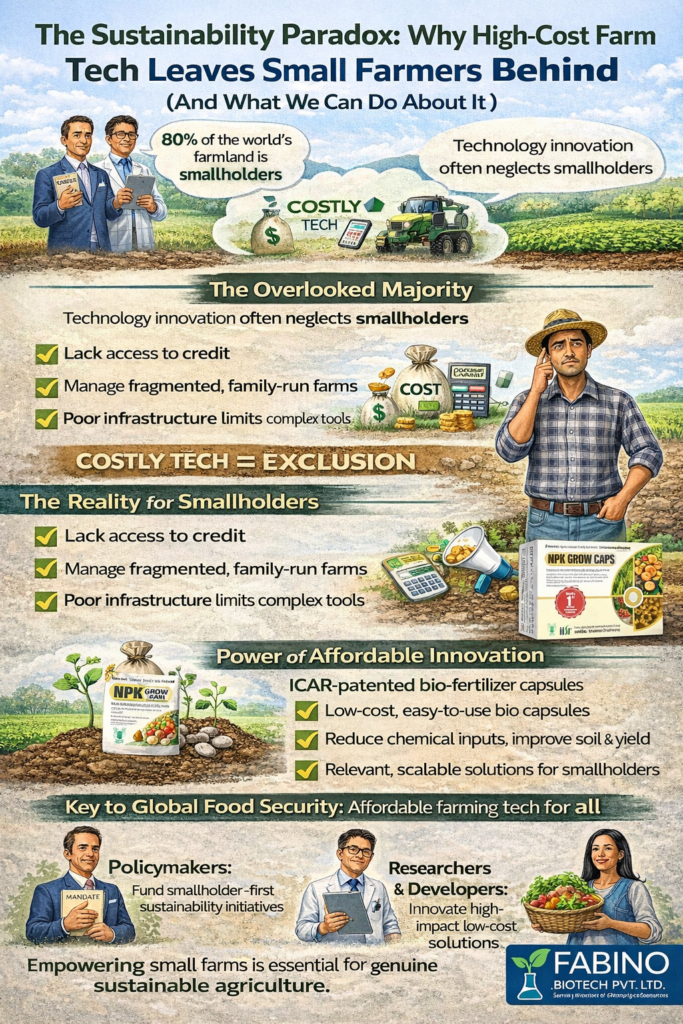
• Targeted, efficient delivery: Encapsulation (capsule, bead, or gel formulations) protects microbes, improves shelf life and field survival, and enables precise, low-dose application — reducing logistics and waste while increasing efficacy. ICAR and others have commercialized encapsulation methods with field evidence of better performance. Indian Council of Agricultural Research+1
• Direct reductions in potent gases: New microbial approaches are showing promise at cutting nitrous-oxide pulses after fertiliser events — recent field work highlights microbes that can sharply reduce N₂O emissions when deployed correctly. AP News
Practical takeaways for stakeholders:
• Policymakers: Invest in R&D, field demonstrations, and procurement schemes that prioritize low-cost, low-carbon bio inputs alongside farmer training. FAOHome
• Agri-business & distributors: Embrace encapsulated bio-formulations for easier storage, transport, and farmer adoption — these lower logistics emissions and broaden market reach. Indian Council of Agricultural Research
• Farmers & advisors: Trial encapsulated bio inputs in small, replicated plots, measure yield and input savings, and scale where benefits are clear.
Bottom line: decarbonization and productivity are complementary goals. Smart biological inputs — delivered in farmer-friendly capsules — offer a pragmatic pathway for “lower emissions + higher yields + restored soils.”
For more information, connect with us :
Email: info@fabinobio.com
Website: www.fabinobio.com
#SustainableAgriculture #ClimateSmartAg #BioFertilizers #SoilHealth #Decarbonization
#RegenerativeAg #Fabino
Sources (selected): FAO agrifood GHG overview; LCA studies showing lower bio-fertilizer life-cycle emissions; ICAR / IISR encapsulation patents & field work; meta-analysis on SOC increases from bio-fertilizers; recent Nature/AP-reported microbial studies reducing N₂O.