A practical, ground-level perspective for farmers, policymakers, and agri-stakeholders
1. Introduction: Farming at a Crossroads
Modern agriculture has delivered higher yields—but at the cost of soil health.
Chemical fertilizers became the backbone of productivity over decades.
Today, declining soil fertility, rising input costs, and climate stress make bio fertilizers not a choice, but a necessity.
Yet, adoption remains slow—this article explores why.
2. Understanding the Hesitation
2.1 Historical Dependence on Chemicals
Chemical fertilizers provided visible and fast results.
Government subsidies and extension systems reinforced chemical use.
Generations of farmers were trained around NPK-based farming models.
2.2 Perceived Effectiveness & Convenience
Chemicals are seen as:
Faster acting
Predictable
Easy to measure and apply
Bio fertilizers are often perceived as:
Slow
Uncertain
“Experimental”
3. Economic Concerns of Farmers
3.1 Cost Anxiety During Transition
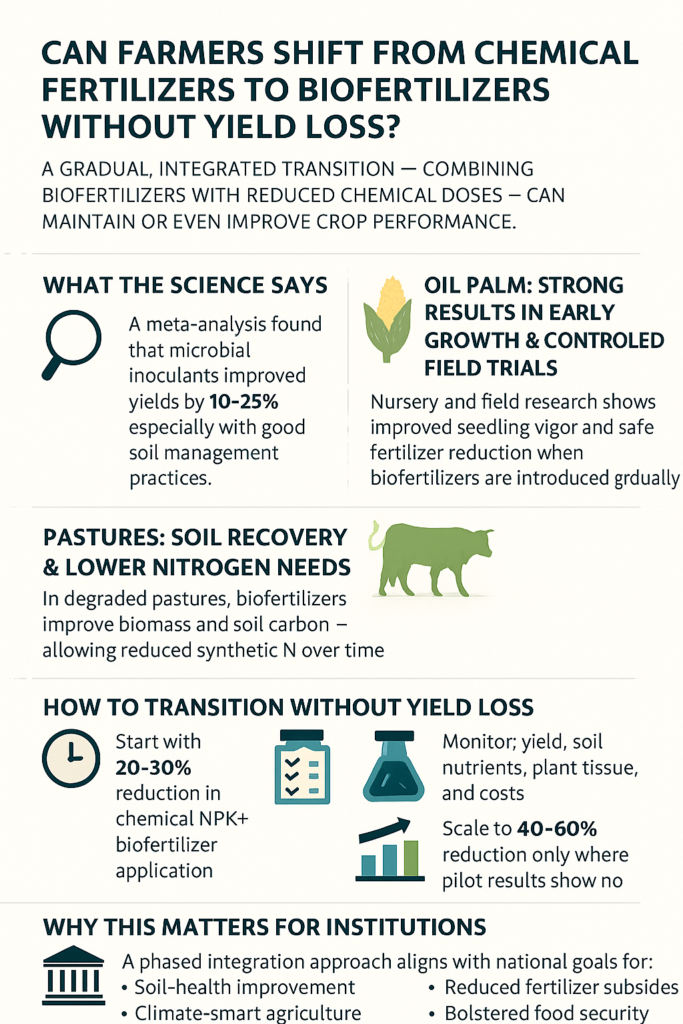
Fear of yield loss during the first 1–2 seasons.
Bio fertilizers are wrongly assumed to be more expensive upfront.
3.2 Availability & Access
Chemical fertilizers are easily available through cooperatives.
Bio fertilizers may not be stocked locally or promoted actively.
3.3 Market & Income Uncertainty
Farmers ask:
“Will buyers pay more for bio-grown produce?”
“Who guarantees my income during transition?”
Lack of assured premium markets discourages risk-taking.
4. Knowledge & Education Gaps
4.1 Limited Awareness
Many farmers are unaware that bio fertilizers:
Improve soil permanently
Reduce long-term input costs
Work best as systems, not single applications
4.2 Insufficient Training & Handholding
Bio inputs require:
Understanding of soil biology
Correct timing & method of application
Absence of field demonstrations reduces confidence.
5. Cultural & Social Factors
5.1 Peer Influence & Community Norms
Farming decisions are deeply social.
If neighboring farmers don’t adopt, individuals hesitate.
5.2 Trust in “What Has Worked Before”
Chemical fertilizers are associated with:
Food security
Green Revolution success
New methods face skepticism unless proven locally.
6. Environmental Concerns & Misconceptions
6.1 Short-Term Yield vs Long-Term Sustainability
Farmers prioritize immediate yield, not long-term soil health.
Environmental benefits feel abstract compared to visible crop output.
6.2 Misunderstanding Bio Fertilizers
Common myths:
“Bio fertilizers are weak”
“They don’t work in degraded soils”
In reality, bio inputs restore microbial life, which chemicals destroy.
7. Conclusion: Bridging the Trust Gap
Key Takeaways
Hesitation is not resistance—it is risk aversion.
Farmers need:
Proof on their own fields
Economic assurance
Continuous guidance
Call to Action
Governments: Support transition subsidies & demonstration plots
Agri-companies: Simplify bio solutions and provide field support
NGOs & FPOs: Build awareness through peer-led success stories
🌱 The future of farming is not chemical vs bio—it is productivity with sustainability.
Helping farmers cross this bridge requires empathy, education, and evidence.